ShieldSENSE® – Human Threat Detection & Protective Awareness Framework
Learn the Lens, Not the Library™
Purpose: Builds protective awareness capability.
ShieldSENSE® is the human threat detection, protective awareness, and resilience capability within the CIRCUIT™ Stack.
Designed to strengthen awareness, anomaly recognition, behavioral interpretation, risk assessment, and protective decision-making, ShieldSENSE® builds the protective awareness capability individuals need to recognize risk before it becomes harm.
At its core, ShieldSENSE® teaches people how to function as calibrated human sensors—capable of establishing environmental baselines, identifying deviations from normal activity, recognizing pre-incident indicators, and making informed protective decisions under uncertain conditions.
Rather than relying on memorized checklists, scripted responses, or static indicators, ShieldSENSE® develops adaptive sensing capability rooted in instinct, environmental awareness, behavioral recognition, and contextual assessment.
Because effective protection begins with the ability to recognize what others overlook.
The RAC™ Cycle
Read. Assess. Counter.™
At the core of ShieldSENSE® is the RAC™ Cycle—the operational decision-making process that transforms sensing into protective action.
While ShieldSENSE® develops the ability to recognize anomalies, behavioral indicators, environmental inconsistencies, vulnerabilities, and emerging threats, RAC™ provides the structured process for interpreting those observations and determining an appropriate response.
Read.™
Establish environmental baselines, observe people and surroundings, recognize anomalies, and identify behaviors or conditions that warrant further attention.
Assess.™
Evaluate context, intent, vulnerability, risk, and potential threat indicators to determine what the anomaly means and whether protective action may be required.
Counter.™
Implement informed, proportionate protective decisions designed to reduce vulnerability, increase safety, and prevent escalation.
RAC™ transforms protective awareness into protective capability.
Because awareness without action provides limited protection.
Building Human Sensing Capability
As proficiency increases, so does a person’s effective detection radius—creating a layered network of awareness where trained individuals collectively strengthen protection across shared environments.
ShieldSENSE® is CTT Global’s flagship framework for building human sensing and protective awareness capability.
Unlike generic awareness programs that rely on memorized indicators or static checklists, ShieldSENSE® develops adaptive sensing capability rooted in instinct, environmental awareness, behavioral recognition, contextual assessment, and informed decision-making.
The result is a distributed network of calibrated human sensors capable of recognizing risk earlier, making better protective decisions, reducing vulnerability, and strengthening resilience across workplaces, public spaces, communities, and high-risk environments.
Learn the Lens, Not the Library.™
ShieldSENSE® Within the CIRCUIT™ Stack
CIRCUIT™ Framework
Provides understanding of how ecosystems function, how outcomes are produced, and how conditions can be influenced.
Doctrine & Ecosystem Understanding
Provides doctrine, intelligence methodologies, standards, ecosystem analysis, operational knowledge, and ecosystem-specific understanding.
CEEDP™
Builds ecosystem disruption and coordination capability.
Restoration Shield™
Builds protective operations capability.
ShieldSENSE®
Builds protective awareness capability through human sensing, behavioral recognition, threat detection, protective decision-making, and resilience development.
Together, these capabilities help organizations understand systems, recognize risk, influence conditions, protect vulnerable individuals, reduce vulnerability, and create lasting impact.
At its core, ShieldSENSE® transforms awareness into capability.
Because systems cannot be understood if risks cannot be recognized.
And awareness remains the foundation of protection.

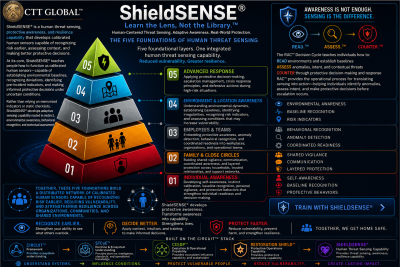
The Five Foundations of Threat Sensing
ShieldSENSE® develops protective awareness through five foundational layers of threat sensing designed to strengthen observation, anomaly recognition, behavioral interpretation, contextual assessment, and protective decision-making across everyday environments and high-risk situations.
Individual Awareness
Developing self-awareness, instinct calibration, baseline recognition, personal vigilance, and protective behaviors that strengthen individual readiness and decision-making.
Family & Close Circles
Building shared vigilance, communication, coordinated awareness, and layered protection across households, trusted relationships, and support networks.
Employees & Teams
Embedding protective awareness, anomaly detection, behavioral recognition, and coordinated readiness into workplaces, organizations, and operational teams.
Environment & Location Awareness
Understanding environmental dynamics, establishing baselines, identifying irregularities, recognizing risk indicators, and assessing conditions that may increase vulnerability.
Advanced Protective Response™
Applying protective decision-making, escalation management, crisis response principles, and defensive actions during high-risk situations and rapidly evolving threat events.
Together, these five foundations build protective awareness capability by creating a distributed network of calibrated human sensors capable of recognizing risk earlier, reducing vulnerability, and strengthening resilience across shared environments and communities.
The 17 Domains of Threat Sensing
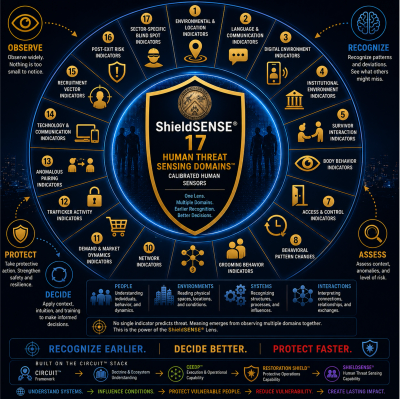
While the Five Foundations of Threat Sensing™ build broad protective awareness and human sensing capability, ShieldSENSE® also includes specialized sensing domains designed to support the recognition of exploitation, grooming, coercion, trafficking dynamics, victimization pathways, and other high-risk human threat environments.
The 17 Domains of Threat Sensing™ provide a structured framework for understanding how exploitation-related behaviors, vulnerabilities, control mechanisms, and environmental indicators may manifest across people, environments, systems, and interactions.
Each domain serves as a specialized lens through which trained individuals build the capability to recognize patterns, identify anomalies, and strengthen protective decision-making.
The 17 Domains
Environmental & Location Indicators™
Recognizing environmental conditions, location characteristics, and spatial patterns associated with vulnerability, exploitation, or elevated risk.
Language & Communication Indicators™
Identifying grooming language, scripted responses, coercive communication patterns, and behavioral inconsistencies.
Digital Presence Indicators™
Recognizing online behaviors, digital footprints, coded language, recruitment activity, and platform-based exploitation indicators.
Institutional Indicators™
Identifying policy gaps, procedural weaknesses, normalized behaviors, and organizational conditions that may enable exploitation to persist.
Survivor Interaction Indicators™
Recognizing trauma responses, compliance behaviors, trauma bonding dynamics, and indicators of coercive control.
Body Behavior Indicators™
Observing nonverbal communication, stress responses, behavioral anomalies, and signs of distress or vulnerability.
Access & Control Indicators™
Identifying restrictions on movement, communication, relationships, finances, transportation, or personal autonomy.
Temporal Disruption Indicators™
Recognizing abnormal routines, timing patterns, scheduling anomalies, and behavioral inconsistencies.
Grooming Behavior Indicators™
Understanding manipulation cycles, trust-building strategies, dependency creation, and exploitation preparation behaviors.
Network Indicators™
Recognizing recurring associations, operational relationships, support structures, and ecosystem connections.
Demand Ecosystem Indicators™
Understanding demand-side behaviors, purchasing patterns, facilitation mechanisms, and exploitation drivers.
Trafficker Control Indicators™
Recognizing intimidation, surveillance, coercion, isolation, dependency creation, and control tactics.
Anomalous Pairing Indicators™
Identifying unusual authority relationships, dependency dynamics, age mismatches, or behavioral inconsistencies.
Technology Usage Indicators™
Recognizing device control, application usage patterns, communication restrictions, encrypted platforms, and digital security behaviors.
Recruitment Vector Indicators™
Understanding recruitment pathways including romance-based approaches, social influence, financial manipulation, modeling scams, and opportunity-based targeting.
Post-Exit Risk Indicators™
Recognizing re-contact attempts, re-engagement behaviors, retaliation concerns, dependency pressures, and re-exploitation risk factors.
Sector-Specific Blind Spot Indicators™
Identifying normalized vulnerabilities, overlooked warning signs, and sector-specific conditions that can obscure exploitation activity.
Each domain is delivered through structured training modules designed to strengthen observation, behavioral recognition, contextual assessment, and protective decision-making.
Each domain serves as a specialized lens through which trained individuals build the capability to recognize patterns, identify anomalies, and strengthen protective decision-making.
Together, the 17 Domains provide specialized lenses through which trained individuals learn to recognize exploitation, interpret complex human behavior, and make better protective decisions.
In doing so, they build specialized exploitation detection, victimization prevention, and ecosystem threat recognition capability.
Expanding the ShieldSENSE® Lens Across Critical Sectors
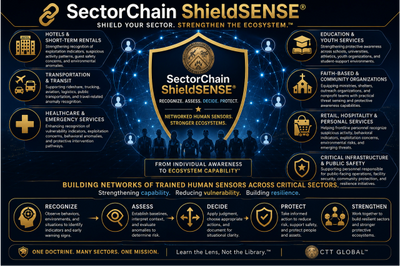
SectorChain ShieldSENSE®
Shield Your Sector. Build Ecosystem Influence Capability.™
SectorChain ShieldSENSE® is the sector-specific deployment model of the ShieldSENSE® framework.
While ShieldSENSE® builds foundational protective awareness capability through human sensing, behavioral recognition, anomaly detection, contextual assessment, and protective decision-making, SectorChain ShieldSENSE® applies those same principles to the environments, workflows, risks, and operational realities of specific industries and sectors.
The objective is not simply awareness.
The objective is capability.
Built upon calibrated human sensing, anomaly recognition, environmental awareness, and contextual assessment, SectorChain ShieldSENSE® helps organizations build ecosystem-wide protective awareness capability by transforming everyday personnel into active contributors to safety, resilience, vulnerability reduction, and ecosystem protection.
Rather than relying solely on policies, reporting procedures, technology, or compliance requirements, SectorChain ShieldSENSE® develops the human capability required to recognize indicators, interpret anomalies, identify vulnerabilities, and make informed protective decisions within real-world environments.
As adoption expands, individual human sensors become connected human-sensor networks, creating ecosystem-level awareness, resilience, and protective capability across organizations, sectors, and communities.
Because stronger sectors contribute to stronger ecosystems.
And stronger ecosystems create safer outcomes.
Sector Applications
Hotels & Short-Term Rentals
Strengthening recognition of exploitation indicators, suspicious activity patterns, guest safety concerns, environmental anomalies, and vulnerability indicators.
Transportation & Transit
Supporting rideshare, trucking, aviation, logistics, public transportation, and travel-related anomaly recognition across complex movement environments.
Healthcare & Emergency Services
Enhancing recognition of vulnerability indicators, exploitation concerns, behavioral anomalies, safeguarding opportunities, and protective intervention pathways.
Education & Youth Services
Strengthening protective awareness across schools, universities, athletic programs, youth organizations, and student-support environments.
Faith-Based & Community Organizations
Equipping ministries, shelters, outreach organizations, and nonprofit teams with practical threat sensing and protective awareness capabilities.
Retail, Hospitality & Personal Services
Helping frontline personnel recognize suspicious activity, behavioral indicators, exploitation concerns, environmental risks, and emerging threats.
Critical Infrastructure & Public Safety
Supporting personnel responsible for public-facing operations, facility security, community protection, resilience initiatives, and protective readiness.
From Individuals to Ecosystems
ShieldSENSE® begins with individuals.
SectorChain ShieldSENSE® expands that capability across organizations.
Together, they create distributed networks of calibrated human sensors capable of recognizing risk earlier, reducing vulnerability, strengthening resilience, and improving protective outcomes across the environments where people live, work, learn, travel, worship, and gather.
The result is not simply stronger awareness.
It is stronger ecosystem influence capability, reduced vulnerability, greater resilience, and more coordinated protection across the sector.