CIRCUIT™ — The Ecosystem Influence Framework™
CIRCUIT™ | The Ecosystem Influence Framework™
The Foundational Layer of the CIRCUIT™ Stack
Purpose: Builds ecosystem understanding capability.
Understand Systems. Influence Conditions. Create Lasting Impact.™
Organizations are often designed to execute a mission.
Few are designed to understand the systems influencing the outcomes of that mission.
As a result, organizations frequently find themselves responding to recurring threats, persistent vulnerabilities, and complex challenges without fully understanding the conditions producing them.
CIRCUIT™ was developed to help close that gap.
As the foundational layer of the CIRCUIT™ Stack, CIRCUIT™ builds ecosystem understanding capability by providing a structured framework for understanding how ecosystems function, how conditions shape outcomes, how vulnerabilities emerge, and how stakeholders can coordinate efforts to influence meaningful and sustainable change.
CIRCUIT™ is not a threat-specific methodology.
It is a universal framework for understanding how complex human ecosystems operate, how outcomes are produced, and how conditions can be influenced to create lasting impact.
The framework helps organizations understand the relationships between people, organizations, environments, processes, stakeholders, threats, vulnerabilities, conditions, and outcomes.
It provides the foundation upon which doctrine and ecosystem understanding, execution and operational capability, and ecosystem influence strategies are built.
The framework is guided by a simple principle:
Conditions create outcomes.
If we want different outcomes, we must understand and influence the conditions producing them.
Because lasting impact requires more than reacting to threats.
It requires understanding the system, identifying the conditions shaping outcomes, aligning stakeholders, building capability, and influencing the ecosystem itself.
CIRCUIT™ answers the first question every organization must address:
How do ecosystems work?
Understanding how ecosystems work is the first step toward understanding how outcomes are produced—and the first step toward creating lasting impact.

What CIRCUIT™ Provides
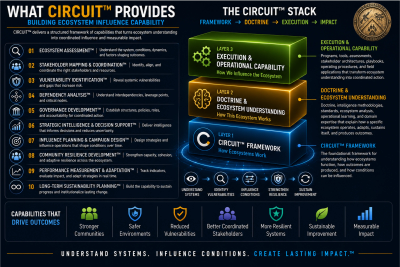
CIRCUIT™ builds ecosystem understanding capability by providing a structured approach for understanding systems, identifying the conditions shaping outcomes, aligning stakeholders, building capability, and influencing meaningful change.
Core capabilities include:
• Ecosystem Assessment™
• Stakeholder Mapping & Coordination™
• Vulnerability Identification™
• Dependency Analysis™
• Governance Development™
• Strategic Intelligence & Decision Support™
• Influence Planning & Campaign Design™
• Community Resilience Development™
• Performance Measurement & Adaptation™
• Long-Term Sustainability Planning™
Together, these capabilities build ecosystem understanding capability, enabling organizations to understand systems, identify conditions, align resources, reduce vulnerability, strengthen stakeholder coordination, and create lasting impact.
The CIRCUIT™ Stack
The CIRCUIT™ Stack organizes the ecosystem influence capabilities developed by CTT Global™ into an integrated architecture that transforms ecosystem understanding into coordinated action and measurable impact.
Layer 1 — CIRCUIT™ - The Ecosystem Influence Framework™
How ecosystems work.
Purpose: Builds ecosystem understanding capability.
The foundational framework for understanding how complex human ecosystems function, how conditions shape outcomes, how vulnerabilities emerge, and how stakeholders can coordinate efforts to influence meaningful change.
Layer 2 — Doctrine & Ecosystem Understanding
How this ecosystem works.
Purpose: Builds ecosystem doctrine and intelligence capability.
Research, doctrine, intelligence methodologies, standards, ecosystem analysis, operational learning, and domain-specific knowledge that help stakeholders understand how particular ecosystems operate, adapt, sustain themselves, and produce outcomes.
Layer 3 — Execution & Operational Capability
How we influence the ecosystem.
Purpose: Builds ecosystem influence capability
Programs, tools, assessments, stakeholder architectures, playbooks, operating procedures, and field applications that enable organizations to act on ecosystem understanding, influence conditions, coordinate stakeholders, and execute ecosystem influence strategies.
Together, these layers answer three fundamental questions:
How do ecosystems work?
How does this ecosystem work?
How do we influence it?
Together, these layers provide a pathway from understanding to action, helping organizations build sustainable ecosystem influence capability rather than relying on temporary interventions.
Understand Systems.
Influence Conditions.
Create Lasting Impact.™
Framework → Doctrine → Execution → Impact
The Bigger Vision
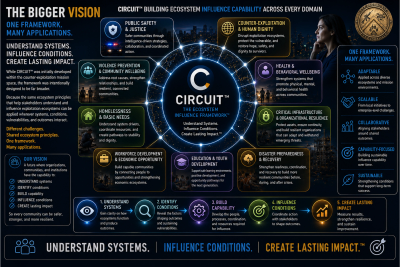
While CIRCUIT™ was initially developed within the counter-exploitation mission space, the framework was intentionally designed to be far broader.
Because the same ecosystem principles that help stakeholders understand and influence exploitation ecosystems can be applied wherever systems, conditions, vulnerabilities, and outcomes interact.
Whether the challenge involves public safety, violence prevention, community resilience, workforce development, homelessness, organizational readiness, education, disaster recovery, critical infrastructure protection, or other complex societal challenges, the underlying reality remains the same:
Outcomes are produced by ecosystems.
People, organizations, environments, stakeholders, resources, incentives, policies, behaviors, and conditions interact continuously to shape the results we experience.
The challenge may change.
The ecosystem principles remain remarkably consistent.
At its core, CIRCUIT™ is not simply a framework for addressing a particular problem.
It is a framework for understanding how complex human ecosystems function, how vulnerabilities emerge, how conditions shape outcomes, and how stakeholders can coordinate efforts to create meaningful and sustainable change.
It is the foundational framework upon which the doctrine, execution, and ecosystem influence capabilities of the CIRCUIT™ Stack are built.
Our vision is a future where organizations, communities, institutions, and leaders possess the ecosystem influence capabilities required to understand the systems they operate within, identify the conditions shaping outcomes, coordinate their efforts more effectively, reduce vulnerability, strengthen resilience, and sustain progress over time.
Because lasting impact is rarely achieved through isolated actions alone.
It is achieved when stakeholders understand systems, influence conditions, build capability, align their efforts, and strengthen the ecosystems that shape outcomes.
Understand Systems.
Influence Conditions.
Create Lasting Impact.™
This is the purpose of CIRCUIT™.
Not simply solving problems.
But building ecosystem understanding capability that enables organizations, communities, and institutions to understand systems, adapt to changing conditions, strengthen resilience, reduce vulnerability, and create lasting impact.
Designing Systems That Influence Systems.™