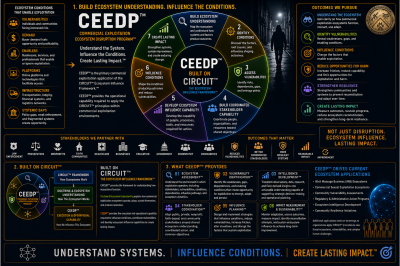
CEEDP™ - Commercial Exploitation Ecosystem Disruption Program™
Understand the System. Influence the Conditions. Create Lasting Impact.™
Purpose: Builds ecosystem disruption and coordination capability.
Commercial exploitation does not survive because of a single offender, business, platform, or victim.
It survives because an ecosystem enables it.
Recruitment pathways, buyer demand, enabling businesses, online platforms, transportation networks, financial systems, vulnerable populations, regulatory gaps, social dynamics, and community conditions interact to create an environment in which exploitation can emerge, adapt, conceal itself, and persist over time.
CEEDP™ was developed to address that reality.
As the commercial exploitation execution and operational capability of the CIRCUIT™ Stack, CEEDP™ builds ecosystem influence and stakeholder coordination capability through ecosystem analysis, intelligence development, stakeholder coordination, influence planning, and targeted intervention.
Rather than focusing exclusively on individual incidents, offenders, or isolated enforcement actions, CEEDP™ examines the broader ecosystem that sustains exploitation and identifies opportunities to influence the conditions, vulnerabilities, and dependencies that allow those systems to operate.
The objective is not simply disruption.
The objective is to build the capability required to influence the conditions that sustain exploitation, reduce vulnerability, strengthen resilience, and create lasting impact.
Because meaningful disruption begins with understanding.
And lasting impact occurs when organizations possess the capability to understand and intentionally influence the conditions enabling exploitation.

Built on CIRCUIT™
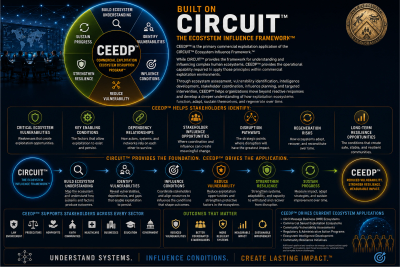
CEEDP™ is the primary commercial exploitation execution and operational capability of the CIRCUIT™ Stack.
CIRCUIT™ provides the foundational framework for understanding how ecosystems function, how outcomes are produced, and how conditions can be influenced.
Building upon that foundation, exploitation-specific doctrine, intelligence methodologies, ecosystem analysis, and operational learning help stakeholders understand how commercial exploitation ecosystems operate, adapt, sustain themselves, and regenerate over time.
CEEDP™ builds the execution and operational capability required to apply that understanding in real-world environments.
Through ecosystem assessment, vulnerability identification, intelligence development, stakeholder coordination, influence planning, targeted intervention, and ecosystem influence activities, CEEDP™ builds the capability organizations need to move beyond reactive responses and understand how exploitation ecosystems function, adapt, sustain themselves, and regenerate over time.
This approach helps stakeholders identify:
• Critical ecosystem vulnerabilities
• Conditions that enable exploitation to persist
• Dependency relationships and leverage points
• Stakeholder influence opportunities
• Intervention and disruption pathways
• Regeneration and adaptation risks
• Long-term resilience opportunities
The result is a more complete understanding of exploitation as a system rather than a series of isolated events.
More importantly, it builds the capability to influence the conditions that shape exploitation outcomes, reduce vulnerability, strengthen resilience, and create lasting impact.
Core Operational Capabilities
CEEDP™ builds a structured ecosystem disruption and coordination capability designed to help organizations understand, assess, influence, and disrupt the conditions that enable commercial exploitation to emerge, adapt, sustain itself, and regenerate over time.
Built upon the CIRCUIT™ Stack, CEEDP™ transforms ecosystem understanding into ecosystem disruption and coordination capability, coordinated action, and measurable impact.
Ecosystem Assessment™
Understanding the environment in which exploitation operates, including stakeholders, vulnerabilities, conditions, dependencies, influence pathways, and ecosystem dynamics.
Vulnerability Identification™
Identifying the weaknesses, gaps, dependencies, and enabling conditions that create opportunities for exploitation to emerge, adapt, and persist.
Intelligence Development™
Transforming observations, data, research, and field-derived insights into actionable understanding capable of supporting strategic decision-making, stakeholder coordination, and operational planning.
Stakeholder Coordination™
Aligning public, private, nonprofit, faith-based, and community stakeholders around shared ecosystem understanding, coordinated action, and common objectives.
Influence Planning™
Designing and implementing strategies intended to influence conditions, reduce vulnerability, increase friction, alter incentives, and disrupt the factors that sustain exploitation.
Targeted Intervention™
Applying coordinated actions across stakeholders, systems, policies, environments, and operational activities to influence conditions, reduce exploitation opportunities, strengthen protective factors, and create measurable ecosystem change.
Impact Measurement & Sustainability™
Monitoring adaptation, measuring outcomes, assessing recovery indicators, identifying ecosystem reconstitution risks, and building the long-term organizational capability required to sustain improvement over time.
Together, these capabilities build ecosystem disruption and coordination capability by transforming ecosystem understanding into coordinated action, ecosystem influence, and measurable impact.
Current Ecosystem Applications
Commercial Exploitation Environments
• Illicit Massage Business (IMB) Ecosystems
• Commercial Sexual Exploitation Ecosystems
• Demand Influence & Reduction Strategies
• Regulatory & Administrative Action Programs
Community & Stakeholder Applications
• Community Vulnerability Assessments
• Stakeholder Coordination Frameworks
• Ecosystem Intelligence Development
• Community Resilience Initiatives
Additional applications continue to emerge as organizations apply CIRCUIT™ principles to new ecosystems, vulnerabilities, and complex human challenges.
As ecosystem understanding expands, so does the opportunity to influence the conditions that shape outcomes, reduce vulnerability, strengthen resilience, and create lasting impact.